


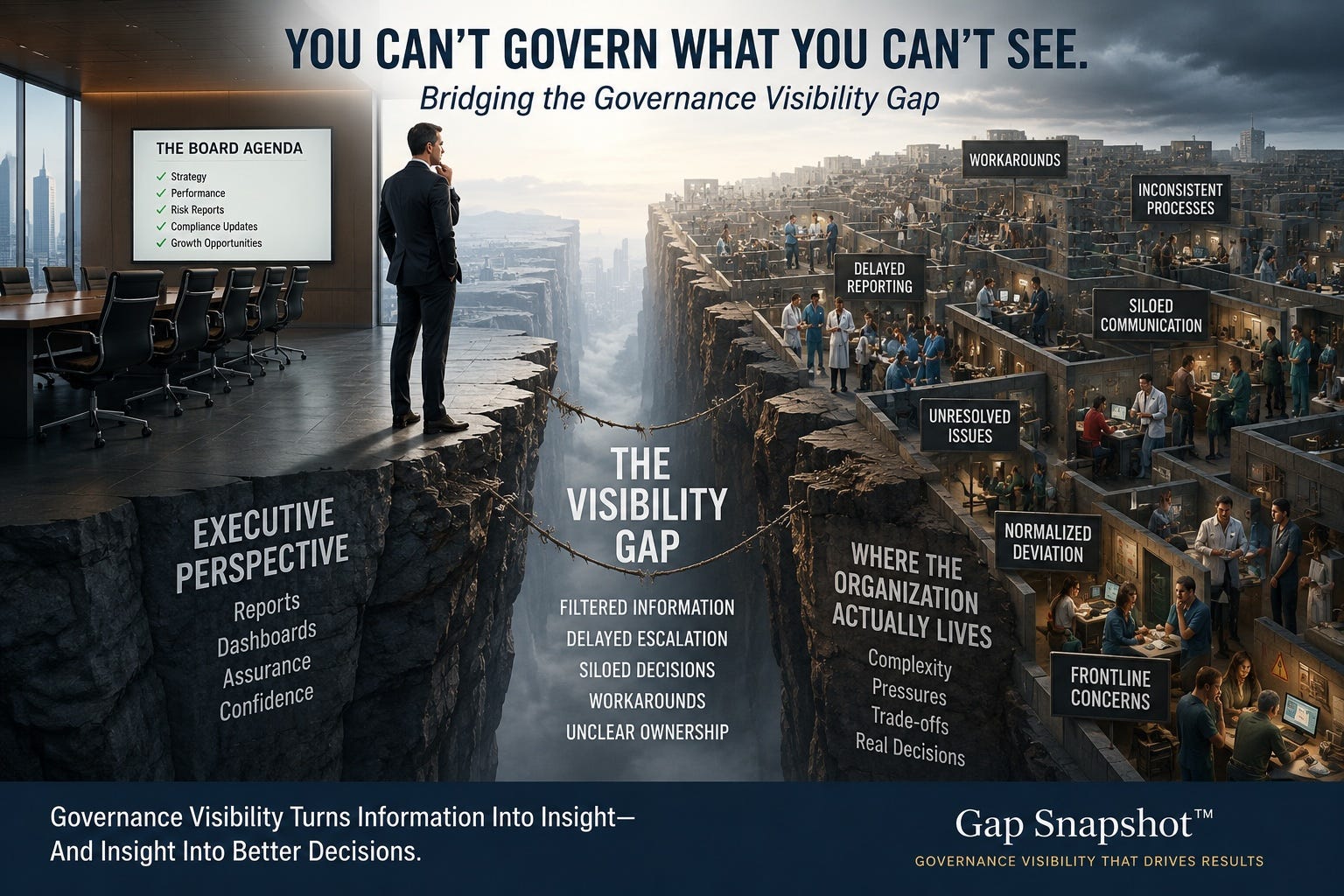
BarkerGilmore recently published an outstanding report, The GC-Board Alignment Gap. It confirms something many governance professionals have observed for years: boards and General Counsel largely agree on what effective governance should look like.
They agree that legal and compliance leaders should be involved earlier.
They agree that enterprise risks should be identified sooner.
They agree that governance should support better strategic decisions.
In other words, alignment isn’t the problem.
Execution is.
I believe BarkerGilmore’s research captures this reality exceptionally well.
As I read the report, however, another question continued to surface.
How do we know whether governance is actually working?
That question shifts the discussion from governance structure to governance effectiveness.
And that shift may be one of the most important conversations facing boards today.
⸻
Alignment Is Important
Good governance begins with alignment.
Boards, executives, compliance officers, legal counsel, quality leaders, internal audit, and operational leaders should share a common understanding of organizational priorities.
Without alignment:
* expectations drift
* accountability weakens
* strategic objectives compete
* oversight becomes inconsistent
Alignment provides direction.
But alignment alone doesn’t guarantee good governance.
Organizations can agree on what should happen while remaining surprisingly unaware of what is actually happening.
⸻
Visibility Is Essential
Every organization produces reports.
Compliance reports.
Quality reports.
Risk reports.
Finance reports.
Audit reports.
The existence of reporting should not be confused with governance visibility.
Reporting tells leadership what people submitted.
Visibility helps leadership understand operational reality.
That distinction becomes critical as organizations become larger and more complex.
Information begins passing through multiple management layers.
Concerns are filtered.
Metrics become summarized.
Narratives are simplified.
Workarounds become normalized.
Eventually, the board receives information that is accurate…
…but incomplete.
The greatest governance risks are rarely hidden intentionally.
More often, they become invisible through ordinary organizational processes.
⸻
Governance Operating Models Matter
Governance isn’t simply a committee structure.
It is an operating model.
It determines:
* who owns decisions
* how information moves
* when risks escalate
* who challenges assumptions
* how corrective actions are verified
* how boards receive meaningful insight
Many governance models were designed when organizations were considerably less complex.
Today’s regulatory environment demands much more than periodic reporting.
It requires continuous governance visibility.
⸻
Decision Architecture
One of the questions that fascinates me most is remarkably simple.
Where are decisions actually being made?
Not where policies say they should be made.
Where they actually occur.
Decision architecture determines whether important concerns move upward—or quietly stop somewhere in the organization.
Every decision has a pathway.
Every pathway contains opportunities for information to be delayed, filtered, or unintentionally lost.
Understanding those pathways may be one of governance’s greatest untapped opportunities.
⸻
Corrective Action Is Not the Same as Improvement
Healthcare organizations close thousands of corrective actions each year.
Yet repeat findings continue to occur.
Why?
Because closing an action item isn’t the same as solving the underlying problem.
True governance asks different questions.
Did behavior change?
Did accountability improve?
Did risk decrease?
Can leadership demonstrate sustained improvement?
Governance should measure outcomes—not simply completion.
⸻
Governance Visibility
This brings us to what I believe is the next evolution in governance.
Governance Visibility.
Governance Visibility asks questions that traditional reporting often cannot answer.
Where are important decisions actually being made?
Where does escalation stop?
Which risks remain invisible?
Where have workarounds become accepted practice?
Do frontline concerns reach executive leadership?
Does the board receive meaningful insight—or simply polished reporting?
Those questions move governance beyond documentation and into organizational intelligence.
⸻
From Visibility to Action
Visibility, however, is never the final objective.
Action is.
Organizations improve when visibility produces better decisions.
When better decisions produce earlier intervention.
When earlier intervention prevents larger failures.
That’s the progression I believe modern governance should pursue.
Alignment ensures leaders share common objectives.
Visibility ensures leaders understand reality.
Action ensures organizations improve before today’s concern becomes tomorrow’s headline.
⸻
Introducing Gap Snapshot™
Gap Snapshot™ was developed around this philosophy.
Rather than evaluating whether governance structures merely exist, it evaluates whether governance is functioning effectively across the organization.
It measures governance visibility.
It evaluates escalation effectiveness.
It examines corrective action sustainability.
It identifies operational blind spots before they become regulatory findings or organizational crises.
Because the goal isn’t simply another report.
The goal is governance visibility that drives better decisions.
And better decisions lead to better outcomes—for patients, employees, boards, and the communities healthcare organizations serve.
______________
-J A Epperson, MBA
Healthcare Governance & Compliance Advisor
I work with healthcare leadership teams to identify where visibility breaks and how governance structures hold under scale. If you’re operating across multiple sites and want a clearer view of how decisions actually function inside your organization, I’m available for select advisory conversations.
Schedule: https://jaepperson.com/schedule
More: https://jaepperson.com
© 2026 J A Epperson Analysis and Advisory Ltd. All rights reserved.