


The Department of Justice recently announced one of the largest healthcare fraud enforcement actions in U.S. history.
The numbers are impressive.
But the governance lesson is even more important.
Federal agencies are no longer relying solely on complaints, whistleblowers, or traditional investigations.
Increasingly, they are using sophisticated analytics to identify patterns that suggest risk long before organizations recognize them internally.
That should cause every healthcare board and executive team to pause.
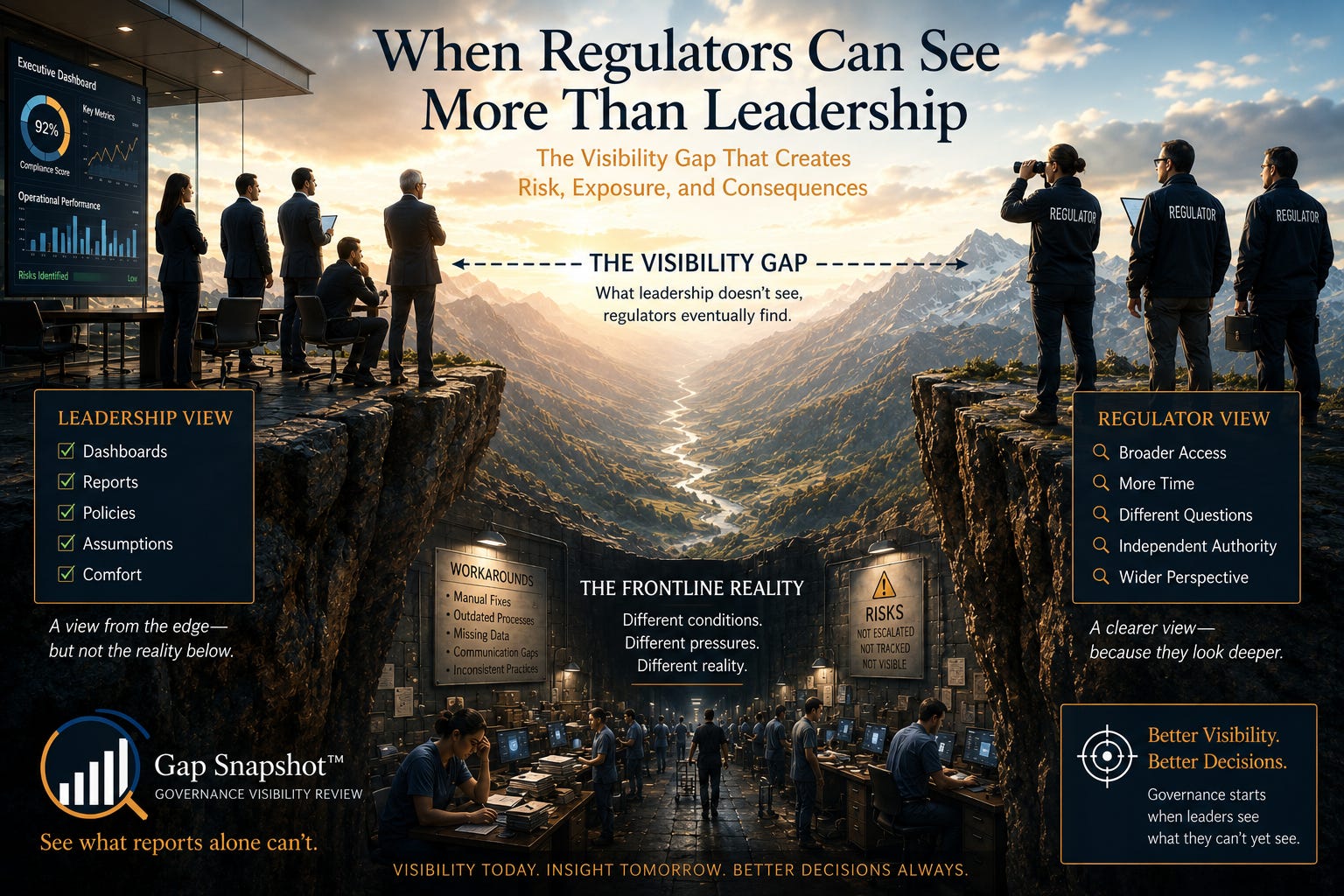
Because if regulators can identify operational patterns from outside the organization…
Why can’t leadership identify them from inside?
⸻
Compliance Has Become Predictive
For decades, healthcare compliance largely operated after the fact.
An incident occurred.
An investigation followed.
Corrective action was implemented.
Today’s enforcement environment is changing.
Analytics now reveal unusual billing trends.
Medical necessity outliers.
Referral relationships.
Controlled-substance prescribing patterns.
Provider enrollment anomalies.
Regulators are asking different questions because they possess different tools.
Healthcare organizations should be asking the same questions.
⸻
Visibility Is Becoming a Governance Responsibility
Many boards receive excellent compliance reports.
That does not necessarily mean they possess excellent governance visibility.
Reporting tells leadership what has already happened.
Visibility helps explain why patterns are developing.
One identifies outcomes.
The other identifies conditions.
Both matter.
⸻
The Gap Leadership Should Be Testing
Every executive team should periodically ask:
Would our internal systems identify the same patterns regulators are seeing?
Could we detect:
• Unusual utilization?
• Inconsistent escalation?
• Corrective actions that failed?
• recurring workarounds?
• departments operating differently from policy?
If the answer is uncertain…
The organization has a visibility question—not merely a compliance question.
⸻
Why Gap Snapshot™ Exists
Gap Snapshot™ was never designed to replace compliance.
It complements it.
The purpose is to examine whether leadership possesses sufficient visibility into the operational realities that eventually create regulatory risk.
Because governance isn’t strengthened by producing more reports.
It’s strengthened by recognizing important patterns early enough to change them.
⸻
Remember This
The most significant lesson from this week’s federal enforcement action isn’t the number of arrests.
It’s that regulators found meaningful patterns before many organizations recognized them themselves.
Healthcare leaders should strive to do the same.
⸻
Continue the Conversation
If this article raises questions about how governance visibility applies within your own organization, I’d welcome the opportunity to continue the conversation.
Gap Snapshot™ Governance Visibility Review
Helping healthcare leaders see what reports alone can’t.
Learn more:
https://jaepperson.com/gap-snapshot
J A Epperson Analysis & Advisory Ltd.
Helping healthcare leaders identify governance blind spots, operational drift, and emerging risks before they become regulatory findings or board-level surprises.
For executive governance advisory information, visit:
https://jaepperson.com/governance-advisory