


Over the years, I’ve come to believe that the best recommendations rarely feel like someone else’s idea.
The strongest governance conversations don’t begin with telling leaders what they’re doing wrong.
They begin by helping leaders see something that was already there—but hadn’t yet come into focus.
That’s the philosophy behind every engagement I do.
Because organizations rarely need more opinions.
They need better visibility.
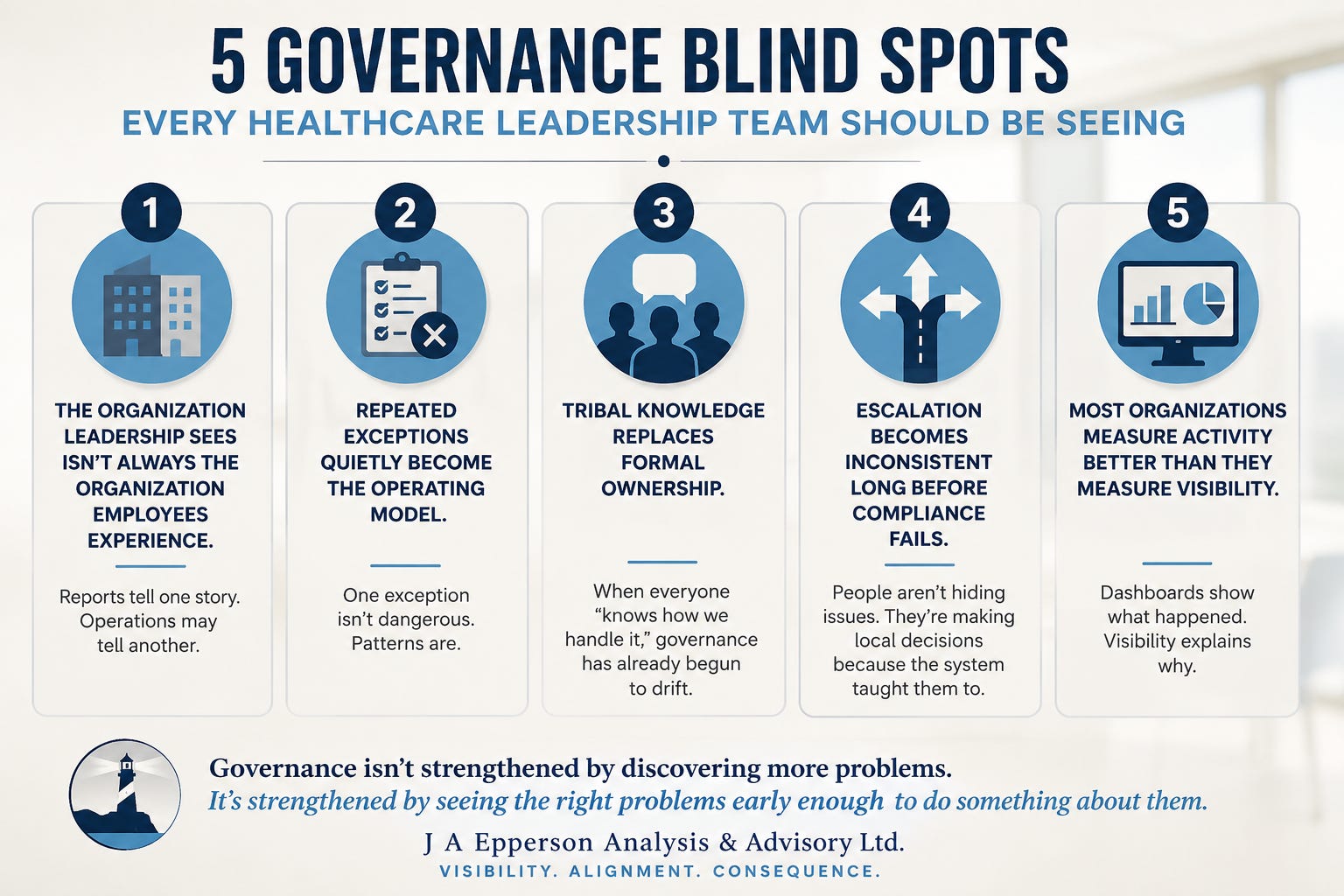
After more than twenty years in healthcare audit, compliance, and governance, I’ve noticed five areas where leadership visibility most often begins to break down.
The Five Governance Blind Spots
1. The organization leadership sees isn’t always the organization employees experience.
Most executive teams govern through information that has already been processed.
They receive dashboards.
Monthly reports.
Escalation summaries.
Board packets.
By the time information reaches leadership, it has usually been filtered, summarized, categorized, and interpreted.
Front-line employees experience something very different.
They experience the small delays that never become incidents.
The workaround everyone quietly accepts.
The supervisor who always makes an exception.
The process that technically exists but no longer reflects how work is actually performed.
Neither perspective is intentionally wrong.
They are simply different.
One describes how leadership believes the organization operates.
The other reflects how work is actually accomplished every day.
The greater the distance between those two perspectives, the greater the governance risk.
⸻
2. Repeated exceptions quietly become the operating model.
Organizations rarely decide to abandon their processes.
Instead, they slowly create exceptions.
An approval gets skipped because everyone is busy.
A form isn’t completed because “we’ve never needed it before.”
One department develops a faster way to accomplish the same task.
At first, these exceptions appear harmless.
Sometimes they are.
The problem begins when exceptions stop being temporary.
People learn them.
Teach them.
Depend on them.
Eventually, the exception becomes the normal process, while the written policy remains unchanged.
Leadership still believes the policy is being followed.
Operations have quietly moved somewhere else.
One exception rarely creates organizational risk.
Hundreds of repeated exceptions create an entirely different operating model.
⸻
3. Tribal knowledge replaces formal ownership.
One of the most revealing phrases inside any organization is:
“We’ve always done it this way.”
Nobody knows exactly when the practice started.
Nobody remembers who approved it.
Yet everyone follows it.
This is tribal knowledge.
It develops naturally as experienced employees solve problems and pass their solutions to others.
Tribal knowledge isn’t inherently bad.
In fact, it often keeps organizations functioning.
The problem arises when tribal knowledge replaces documented ownership and defined accountability.
When important processes depend upon institutional memory rather than organizational design, consistency begins to disappear.
New employees learn people instead of policies.
Leadership loses visibility into how decisions are actually being made.
Eventually, no one owns the process because everyone simply inherited it.
⸻
4. Escalation becomes inconsistent long before compliance fails.
Most employees want to do the right thing.
Most managers want to solve problems.
That is exactly why inconsistent escalation develops.
Employees often make local decisions because they believe they are helping.
They don’t want to burden leadership.
They don’t want to delay patient care.
They don’t believe the issue is significant enough to report.
Sometimes they have learned through experience that escalation produces little response.
Sometimes they fear being viewed as someone who creates problems.
Whatever the reason, people begin solving issues locally rather than consistently escalating them.
Leadership assumes everything is operating normally because fewer issues are being reported.
In reality, fewer issues are simply reaching leadership.
That distinction matters.
Because compliance failures usually occur long after escalation failures have already become part of the culture.
⸻
5. Most organizations measure activity better than they measure visibility.
Healthcare organizations are exceptionally good at measuring activity.
Training completion.
Incident counts.
Audit findings.
Policy acknowledgments.
Productivity.
Quality scores.
These measurements are important.
But activity does not always equal visibility.
A dashboard can tell leadership that training reached 100 percent of employees.
It cannot tell leadership whether employees feel confident making the right decision when uncertainty appears.
A report can show that incidents decreased.
It cannot explain whether fewer incidents occurred—or whether fewer incidents were reported.
Metrics answer:
“What happened?”
Visibility answers:
“Why did it happen?”
Organizations that measure both activity and visibility make better governance decisions because they understand not only the outcome, but the conditions that produced it.
⸻
Why This Matters
This is exactly why I developed Gap Snapshot™.
Not as another audit.
Not as another compliance review.
As a visibility review.
One designed to answer a simple question:
Are leadership and the front line experiencing the same organization?
⸻
Remember This
Governance isn’t strengthened by discovering more problems.
It’s strengthened by seeing the right problems early enough to do something about them.
Continue the Conversation
If this article resonated with you, there are two ways to continue exploring these ideas.
📍 Gap Snapshot™ Governance Review
See how a Gap Snapshot™ helps leaders identify governance blind spots before they become larger organizational risks.
https://jaepperson.com/gap-snapshot
📖 Character & Consequence
https://characterandconsequence.substack.com

Thank you for reading.
J A Epperson
Healthcare Governance & Operational Visibility Advisor
J A Epperson Analysis & Advisory Ltd.
⸻
© 2026 J A Epperson Analysis & Advisory Ltd. All rights reserved.